 Riu Riu Chiu appears on Ken and Lisa Theriot’s latest album, The Gifts of Midwinter.
You can listen to the song below:
Lisa Theriot says: “Ríu, ríu, chíu” is a very popular song, considering it dates from the 16th century and was only seemingly preserved in one copy. Add to that the fact that the single extant copy was a collection of Iberian folk-style songs (or “villancicos”) printed in Venice in 1556 and archived in Sweden, and you have to consider it miraculous that the song exists at all.
Lisa researched and translated the song, the story of which follows:
Adventures in Translation: Riu, Riu, Chiu
by Lisa Theriot
Personally, I would never sing a song if I didn’t know what I was actually saying; you could turn out to be reciting somebody’s recipe for lutefisk or inviting the goatherds over for breakfast. Plus, you miss the “in” jokes. When I was working on the liner notes for “Gifts of Midwinter” I decided it was important to provide translations for the non-English songs.
The first song I looked at was “Riu, Riu, Chiu,” from the “Cancionero de Upsala” printed in 1556. Now right from the start, this song is a child of the Tower of Babel; the “Cancionero de Upsala” is so known because the only surviving copy belongs to the collection of Uppsala (the correct spelling!) University Library in Sweden. It was, however, printed in Venice, and it is a collection of mostly Spanish songs, with a few in Catalan, and one each in Latin and in Galician Portuguese. How’s that for international [1]? Most scholars seem to agree that the song was written by Mateo Flecha el Viejo (1481-1553), aka Mateu Fletxa el Vell ‘the Elder’ in Catalan, even though his name is not attached to the song in the Cancionero.
For a brief moment I thought about being lazy and getting a translation from the web. But then I noticed two things; first, most of the online translations weren’t very good, and second, that most of the online translations skipped my favorite verse! Really, check the ChoralWiki page, sadly copied and spread across many websites, and you’ll see they have two slightly different translations for verse 2, given as English verses 2 and 3, then verse 3 (English 4), verse 4 (English 5), verse 5 (English 6), and verse 7 (English 7). No translation for verse 6!
So here is my translation. I have tried to translate as exactly as possible while fixing the grammar for English and abiding by certain poetic niceties. I translate “de carne vestido” as ‘clothed in flesh’ rather than what jumped out at me as literal, namely, ‘dressed in meat’ (ewwwww). “Riu, riu, chiu” is meant to be onomatopoeia for birdsong, though the type of bird is still under debate (leading candidates are the nightingale, for the beauty of his song, and the kingfisher, because of the concept of guarding the riverbank). [Update: Having just found a You Tube video of a Kingfisher making a cute chirpy sound (as opposed to the gravel/rattle “you kids get off my lawn” that I normally associate with them), I’m starting to come around to the argument for the Kingfisher.]
[1] The real title is Villancicos de diuersos Autores, a dos, y a tres, y a qvatro, y a cinco bozes, agora nvevamente corregidos. Ay mas ocho tonos de Canto llano, y ocho tonos de Canto de Organo para que puedam aprouechar los que, A cantar començaren. Venetiis, Apud Hieronymum Scotum, MDLVI. That’s ‘Villancicos from divers authors, for 2, and for 3, and for 4, and for 5 voices, now newly corrected. There are also 8 tones of plainchant, and 8 tones of organum for the benefit of those that are still learning to sing. Venice, by Hieronymus (Girolamo) Scotto, 1556.’ As you can see by the title page (opposite), the spelling weirdnesses are due to the alternating use of all capital letters in some lines but not others, so <Autores> ‘authors’ has a <u> where it should, but <nvevamente> (nuevamente) ‘newly’ has a <v>, etc.
Riu, Riu, Chiu
| Chorus: Riu riu chiu, la guarda ribera; Dios guardo el lobo de nuestra cordera, Dios guardo el lobo de neustra cordera. |
<tweet>, the river keeps As God from the wolf keeps our lamb As God from the wolf keeps our lamb |
| El lobo rabioso la quiso morder, Mas Dios poderoso la supo defender; Quiso la hacer que no pudiese pecar, Ni a’un original esta Virgen no tuviera. |
The rabid wolf wants to bite her But God the powerful knows to defend her He wanted to make her unable to sin Nor did original sin this virgin have |
| Este qu’es nacido es el gran monarca, Christo patriarca, de carne vestido; Hanos redimido con se hacer chiquito, Aunqu’era infinito, finito se hiziera. |
He who is born is a great monarch Christ, our father, clothed in flesh We have redemption from this tiny creation Though infinite, finite he was made |
| Mira bien que os quadre que ansina lo oyera, Que Dios no pudiera hacer la mas madre, El quera su padre hoy della nascio Y el que la crio su hijo se dixera.Chorus: |
Mark well the rightness of what you have heard That God could not make her more a mother He that is her father is today of her born He of whom she is the child is called her son |
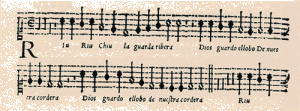
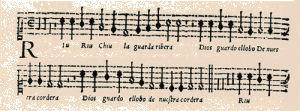
Here’s the original melody line according to the 1556 work. Sadly, I didn’t discover this at the University’s website until after the album was done, so we don’t sing it exactly this way. But neither does anyone else.
https://www.ub.uu.se/en/Collections/Music-collections/Some-treasures/Cancionero-de-Uppsala/
©2011 Raven Boy Music
I have just posted complete and rhyming translations of “Riu Riu Chiu”, all 7 verses, into English and Esperanto, with a simple melody line matched to every syllable of every verse.
https://www.genekeyes.com/RIU/Riu.html
Very cool. Thanks Gene.
I like this translation; it sheds some light on things I couldn’t make sense of. Why did you translate the past tenses into present tense, though? I’ve never seen a translation of the first line that made sense to me, but as I was looking at your translation, it suddenly occurred to me that if one made “guarda ribera” into a single word, the phrase would mean “the(f) guardian of the river”. That goes well with the kingfisher hypothesis also.
Couldn’t la guarda ribera mean she (meaning the bird) guards the river.
Thanks for your informative article.
Elizabeth, the whole thing changes tense back and forth as it changes from actions to ideals and back again. I kind of split the difference. And yes, if it IS a kingfisher, known in some times and places as “river guarder”, that changes the first line to ‘Tweet (says) the kingfisher.’ I’m not quite sure why there is such a strong association in Spain with birds and Christmas, but there is. The “Carol of the Birds” is another one of my favorites.